Turbo League
- 3.5
- Rating
- 10.00M
- Installs
- Free
- Price
 Analysis by App-foxy
My first few matches with Turbo League made its central idea clear almost immediately: this is a racing game built around rocket-powered cars playing soccer. That combination gives every possession a sense of motion, because I am not simply trying to reach a finish line or pass a ball across a field. I am constantly judging speed, angle, distance, and the risk of leaving my position at the wrong moment.
The game is free to download, and its broad Everyone age rating makes it easy to recommend as a casual game for a mixed group of players. It comes from ZEROFOUR GAMES PUBLISHER L.L.C and has been available since December 29, 2016. That long presence helps explain why it has attracted more than ten million installs, although the average score of 3.5 from roughly one hundred fifty-five thousand ratings also suggests that the experience will not suit every player.
I think the best way to approach it is not as a full replacement for a traditional football game or a serious racing simulator. It is a compact arcade interpretation of both ideas, with the car doing the work of the player. That choice creates an energetic mood, but it also makes the controls and match flow more important than realism. When the steering feels natural, a small touch can become a satisfying goal. When positioning goes wrong, the same speed that makes the game exciting can leave me completely out of the play.
You May Also Like

 Blood Strike: 2.5 Anniversary
Blood Strike’s Loadouts Turn Every Drop Into a Tactical Gamble
A close look at Blood Strike’s custom loadouts: how fast access to signature weapons reshapes its battle royale rhythm, rewards preparation, and narrows the gap between fights.

 Pandora - Music & Podcasts
Pandora’s Music Is Easy to Start, but Harder to Recover
Pandora’s strength is its low-effort path from a seed to a station. Its weak spot is how much confidence it asks you to place in connection, setup, and quiet recovery.

 8 Ball Pool
 Is Built on Rivalries, Rematches, and Routine
A close look at the rivalries, rematches, shared routines, and unanswered safety questions that turn a quick pool match into a persistent mobile community.

 Samsung Music
’s Quiet Strength Is Playing What You Already Own
Its reach comes less from spectacle than from dependable access to a personal library. That simplicity is both the app’s strongest retention engine and its ceiling.

 AccuWeather: Weather Radar
AccuWeather Review: A Quick, Clear Forecast for Everyday Decisions
For everyday plans, the best forecast is the one you can understand quickly. AccuWeather makes rain timing, radar, and local conditions easy to act on, with a few trade-offs.

 Hill Climb Racing
Why Hill Climb Racing Still Turns Crashes Into One More Run
A tiny car, a bumpy hill and one more upgrade: Hill Climb Racing keeps resurfacing because its simple chaos makes every near-miss feel personal.
More From Our News Desk



From bright first impression to playable mood
I like how Turbo League makes its unusual car-and-soccer premise readable before asking me to think about tactics. In this section, I’ll look at how the arena, sound, and match rhythm shape that first impression, then turn to the more deliberate choices that keep the action from being just a rush toward the ball.
The opening appeal is easy to understand
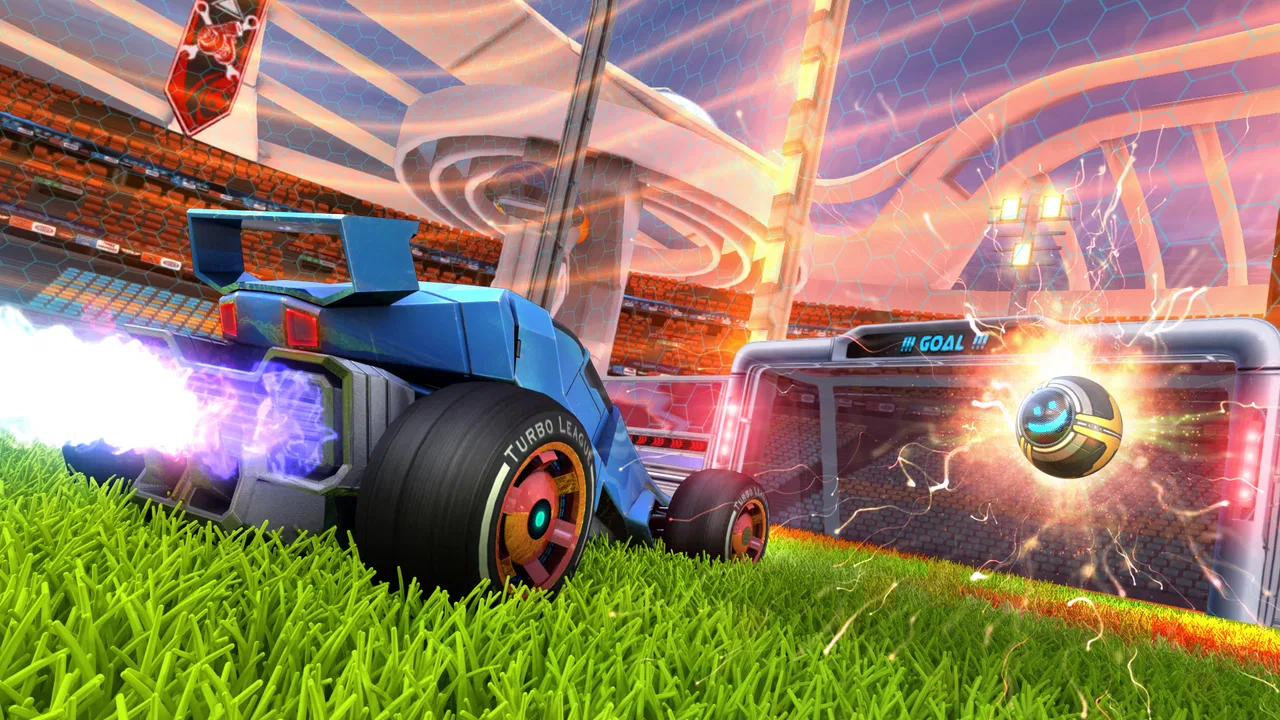
The visual concept communicates itself without much explanation. Cars, a ball, a goal, and a boost-driven arena are enough to tell me what kind of match I am entering. The setting is not trying to imitate a real stadium in a detailed sports simulation style. Instead, it presents a focused play space where the important objects remain easy to identify while vehicles move quickly around them.
That clarity matters on a phone. In a conventional racing game, the road usually tells me where to look. Here, the ball can move in a different direction from my car, and another vehicle can change the situation in a moment. The art direction therefore has a practical job: it needs to keep the arena readable while still making the action feel lively. In my experience, the simple, game-like presentation supports that goal better than a crowded or overly realistic design would.
The first impression is strongest when I treat each match as a short burst of concentration rather than a long sporting event. I can pick up the game during a break, play a few rounds, and stop without needing to build a long campaign routine. That makes it more approachable than many racing games that expect extended sessions to unlock vehicles, learn tracks, or improve lap times.
Why the setting works better than a conventional pitch
A normal soccer field is designed around human movement, while this game’s arena is shaped by vehicles with sudden acceleration. The setting feels coherent because the open space gives the cars room to build momentum, approach the ball, and recover after a missed challenge. I rarely feel that the cars are being forced into a football match that was designed for people on foot. The arena supports the exaggerated movement.
That design also changes how I read distance. A ball that appears safely away can become reachable after a boost, while a nearby ball may be difficult to control if my car is facing the wrong way. The visual simplicity encourages quick decisions, but it does not remove the need to understand momentum. This is one of the more interesting details of the game: the bright, accessible presentation hides a small amount of spatial discipline underneath.
Players looking for detailed car customization, realistic tracks, or a broad motorsport setting may find the world too narrow. The game’s identity comes from repeating the same unusual sports premise in different moments, not from presenting a large driving universe. I see that as a strength for focused arcade play, but a limitation for anyone who wants a deeper racing career.
Reading the action instead of chasing every movement
One useful habit I developed was to watch the ball’s likely path rather than following it blindly. New players may instinctively drive straight toward it whenever it moves. That often creates a late arrival, especially if another car reaches the ball first. I get better results by approaching from an angle and leaving enough space to react to the next bounce or deflection.
This is where the art direction and mechanics meet. Because the field is visually direct, I can spend less attention decoding scenery and more attention reading the relationship between my car, the ball, and the goals. The game does not need a complicated visual language to create tension. A small change in angle can be enough to make a familiar arena feel different from one possession to the next.
Sound gives the matches their pulse
The sound design contributes to the feeling that every play is a small mechanical event. The important audio moments are tied to movement, contact, and the general sense of speed. I do not experience the matches as quiet puzzle sessions; even when I am waiting for the right approach, the game maintains an arcade rhythm that encourages me to stay engaged.
That rhythm is useful because the rules are simple but the timing is not. Audio feedback helps reinforce the idea that the car has made contact or that the action has shifted. It gives the match a stronger pulse than the visuals alone would provide. I find that especially helpful when several cars converge and the screen becomes harder to read for a moment.
At the same time, the presentation is not built around a dramatic sports broadcast atmosphere. I would not choose this game for commentary, realistic crowd immersion, or the emotional build-up of a televised match. Its mood is closer to a lively arcade cabinet translated to a mobile screen. The sound supports quick reactions and playful energy instead of pretending that every goal is a major sporting occasion.
How pacing keeps a simple idea fresh
The pacing comes from alternating between calm positioning and sudden bursts of action. I may spend a few seconds correcting my approach, then immediately need to react to a deflection or a fast counterattack. That contrast prevents the game from becoming a repetitive exercise in driving directly at the ball.
It also creates a useful distinction between beginners and more experienced players. A beginner can enjoy the excitement of boosting toward an opportunity, while a more careful player can focus on arriving at the right time and preserving a useful position afterward. The same match therefore supports two styles: impulsive arcade play and more deliberate interception.
There is a trade-off here. If I want a predictable, steadily escalating race, the shifting pace may feel messy. The game does not provide the clean feedback loop of improving a lap by a fraction or memorizing a track corner. Its satisfaction comes from reacting to a live, changing situation. That makes it more social and spontaneous than a standard time trial, but less controlled for players who prefer measurable racing progress.
The controls reward restraint as much as speed
The central mechanical challenge is not simply reaching the ball first. It is controlling the car well enough to make the contact useful. A fast approach can send the ball in an unexpected direction, and a poorly aligned car may lose its advantage immediately after touching it. I learned to value small corrections, especially near the goal, where a full-speed arrival can be less effective than a slower approach from the side.
Boosting is most satisfying when I use it with a purpose. I can spend it to close a gap, recover after a mistake, or turn a defensive position into an attacking run. Using it every time it is available makes the match feel frantic, but not necessarily productive. My practical tip is to keep a little patience before committing: if the ball is already moving toward a dangerous area, a controlled angle may matter more than maximum speed.
This is one of the game’s less obvious strengths. The store summary emphasizes rocket-boosted cars and intense soccer, but the enjoyable part is learning when not to behave like a rocket. The game becomes more satisfying when I stop treating every moment as a race and start thinking about momentum management.
What it feels like in an everyday session
A realistic use case for me is a short evening session after finishing a task. I can start with the intention of playing one match, discover that the first result came from a bad angle rather than bad luck, and play again with one small adjustment. That kind of immediate retry works well on a mobile device because the lesson is easy to remember: approach from a better side, save the boost, or stay closer to the defensive area.
It is also suitable for someone who wants a game that can be understood by watching a single round. A friend does not need to learn a complicated set of racing rules before joining the conversation. The unusual combination of cars and soccer is visible on the screen, and the goal of each play is straightforward.
I would be more cautious about recommending it to someone who dislikes repeated short matches or who expects a deep solo progression system. The appeal depends heavily on the moment-to-moment contest. If that loop does not feel good after a few games, extra time is unlikely to transform it into a different kind of racing experience.
Free access is helpful, but spending needs attention
The free entry point is a genuine advantage. I can test the driving feel and decide whether the car-soccer format works for me without paying before understanding the basic loop. That is particularly useful here because the game’s appeal is highly personal: some players immediately enjoy the chaos, while others prefer more conventional racing or football controls.
There are in-app purchases ranging from $0.99 to $99.99 per item. That range makes it sensible to treat optional spending carefully, especially if the game is being installed for a younger player. The Everyone rating describes the content audience, not a promise that every purchase decision will be equally suitable for every family. I would set a device spending boundary before handing the game to a child.
My own recommendation is to play enough free matches to judge the handling, pacing, and visual readability first. A purchase cannot fix a control style that already feels uncomfortable. If the basic loop is enjoyable, optional items may add interest; if it is not, spending more only increases the cost of a poor fit.
Device expectations and practical compatibility
The current version is 3.2, and the listed minimum operating system is Android 7.0. That makes the game accessible to a broad range of Android devices, though an older phone can still affect how comfortable fast action feels. Racing and ball movement demand quick visual reactions, so a device that struggles with responsiveness can make the game seem less precise than it really is.
I would test the controls in a quiet setting before judging the game too harshly. Touch input can feel different depending on screen size and how I hold the phone. A larger display may make the arena easier to read, while a smaller one can make crowded moments feel more compressed. The game’s direct visual style helps, but it cannot eliminate the physical limits of a particular device.
Players who mainly use iOS should check the appropriate platform availability before planning a shared session. I would also avoid assuming that a mobile game with a simple premise will feel identical on every phone. The most important question is whether steering and acceleration respond consistently enough for small positional corrections, because those corrections are central to successful play.
How it compares with ordinary racing and football games
Compared with a standard racing game, this title gives up track mastery and lap-time precision in exchange for unpredictable interaction. There is no single ideal line that guarantees a good result. The ball, opponents, and changing positions keep creating new problems. I prefer this when I want a more social or reactive experience, but I would choose a conventional racer when I want to practice corners, tune a vehicle, or chase a personal best.
Compared with a traditional football game, the cars make movement faster and less physically intuitive. I do not control a player who can stop, turn, and pass with human-scale precision. Instead, I manage a machine that carries momentum into every challenge. That makes the game easier to understand at the rule level but harder to master at the contact level.
It also differs from a serious competitive sports game because its mood is more playful than authentic. The visual setting, sound, and pacing all support the fantasy of machines turning a football match into an arcade contest. If I want realism, licensed teams, tactical formations, or a slower strategic build-up, another option is clearly better. If I want a fast match with an unusual hook, this is the more distinctive choice.
Who should try it, and who should skip it
I would recommend it to players who enjoy arcade racing, quick competitive rounds, and games that are understandable within moments but reveal better decision-making over time. It is especially appealing if the idea of using a car as both athlete and ball-control tool sounds more interesting than another ordinary driving game.
I would also suggest it to casual groups. The rules are easy to explain, and the visual premise gives spectators something to follow. A player does not need to know football tactics or racing terminology to understand why a well-timed approach matters. That makes the game a friendly choice for occasional play rather than a hobby that demands a long tutorial.
I would skip it if I need a realistic racing simulation, a detailed football management experience, or a calm game with no sudden reversals. I would also be cautious if I dislike touch controls that require constant adjustment. The game’s strongest moments depend on handling momentum, so anyone who wants a perfectly predictable response may find its arcade physics frustrating rather than exciting.
The final atmosphere is coherent, even when the action is rough
What stays with me is how consistently the presentation serves the mechanic. The bright arena makes the ball and cars easy to follow, the sound keeps contact and movement feeling active, and the pacing turns simple rules into a sequence of small decisions. None of these elements needs to be elaborate on its own. Together, they create a playable mood that feels faster and more focused than the basic premise might suggest.
The game is not flawless. The average rating of 3.5 indicates a divided response, and I understand why: the same momentum-driven action that gives the matches personality can also produce awkward misses, confusing rebounds, or moments where a result feels less controlled than expected. The purchase range may also require sensible limits for families, and players wanting a large racing world will find the concept deliberately narrow.
Still, I think Turbo League earns a place among mobile arcade games because it has a clear identity. It does not merely place cars on a field for decoration; the vehicles change the rhythm, the positioning, and the meaning of a successful play. I would start with the free version, focus on controlled approaches rather than constant boosting, and decide based on whether that unusual blend of speed and soccer feels satisfying.
My final recommendation is therefore specific: try it when you want energetic, short-form competition with a playful setting and a little more mechanical depth than the first match suggests. Choose a conventional racer for track improvement, or a traditional football game for authentic tactics. But if you want to turn acceleration, angle, and timing into a strange kind of football skill, this game delivers a coherent experience that is easy to enter and rewarding to understand.
FAQs for Turbo League
01What is Turbo League and how does it work?
Turbo League is a fast-paced multiplayer game that combines elements of soccer with vehicular action. Players control cars to hit a giant ball into their opponent's goal. The game offers various modes, including solo and team play, and features realistic physics to enhance the gaming experience.
02Is Turbo League available on both Android and iOS?
Yes, Turbo League is available for both Android and iOS platforms. You can download it from the Google Play Store for Android devices and the Apple App Store for iOS devices. Ensure your device meets the necessary system requirements for a smooth gaming experience.
03What are the main features of Turbo League?
Turbo League features real-time multiplayer matches, customizable cars, and realistic physics. Players can participate in online tournaments and team up with friends. The game also offers a chat feature for players to communicate during matches and a variety of arenas to enhance gameplay.
04Are there any in-app purchases in Turbo League?
Yes, Turbo League includes in-app purchases. Players can buy cosmetic items, new cars, and customization options. While these purchases can enhance the visual aspect of the game, they are not necessary to enjoy the core gameplay, which remains accessible to all players.
05What are the pros and cons of playing Turbo League?
Pros of Turbo League include its engaging multiplayer mode, customizable vehicles, and realistic physics. However, some players find the controls challenging at first, and there may be occasional connectivity issues in multiplayer mode. Overall, it offers a thrilling gaming experience with a few minor drawbacks.
Pros
- Realistic physics enhance gameplay.
- Customizable cars add personal touch.
- Cross-platform multiplayer available.
- Simple and intuitive controls.
- Frequent updates with new features.
Cons
- Graphics could be more detailed.
- Occasional server connectivity issues.
- Limited variety of game modes.
- In-app purchases can be costly.
- Advertisements can interrupt play.

Turbo League
Gallery